A bio in roughly the wrong order.
From Kampala in the 1990s to Edmonton today — ICT, global health, AI policy, and the systems that work for people versus the ones that quietly stop working on people.
There is a particular kind of child who, by twelve, has already taken the back off the family radio just to see what is inside. I was one of them. Kampala in the 1990s turned out to be an excellent place to be that kid: Linux discs got passed around like contraband, broken motherboards moved through Owino Market by weight, and adults with degrees in actual disciplines would occasionally hand you, a teenager, their printer and a hopeful look. What you learned, very quickly, was that systems either work for people or quietly stop working on people. That distinction has been the through-line of everything since.
I am writing this from Edmonton, Alberta, where I now live and where, for several months of the year, the air outside is openly hostile to mammals. I came here from Liberia, before that a stretch bouncing between Uganda, Malawi, Kenya and Nepal, before that New York City, and before all of that, Kampala.
The shape of my career on a map looks like someone tried to draw an itinerary on a wet napkin. The shape of it in my head is much more linear: every job I have had has been some version of the same question — whether the system the project diagram describes is the same one the user will actually encounter on a Tuesday.
Kampala, originally
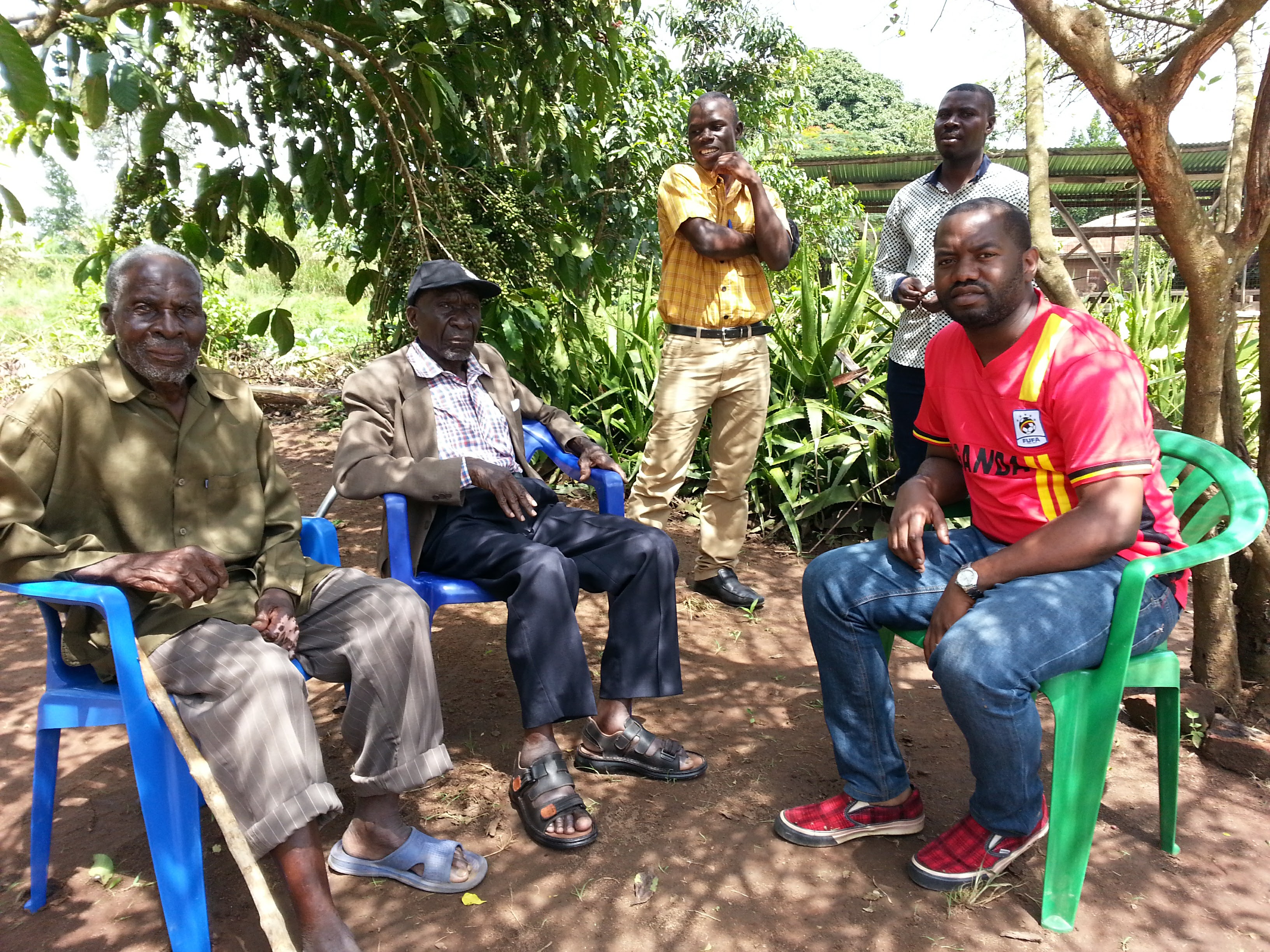
Makerere University taught me Computer Science between 2002 and 2006, in classrooms where the curriculum lagged the field by about a decade. The Linux User Group in Kampala — half hobbyists, half evangelists, all on dial-up — turned out to be the best graduate school I ever attended. I fell in love with ICT so much I became a co-founder of the ICT Association of Uganda.
My first proper job, in 2008, was IT Manager at Uganda Chartered HealthNet. UHIN was attempting what we would now call mobile health — except smartphones did not exist yet, so we were doing it on PDAs and early Symbian handsets — moving data from rural clinics to district health offices on technology held together with prayer and the goodwill of MTN's signal towers. I managed 150 devices across 21 data collection points and spent a remarkable amount of my professional life on the back of boda bodas in muddy weather in eastern Uganda, on my way to fix something that was almost always cabling. In 2010, AED-Satellife gave me an Achievement Award for "innovative use of digital tools to strengthen public health data infrastructure," which I am now fairly certain was a polite way of saying the cabling guy.
The Linux Sysadmin decade
From 2010 to 2013, I was ICT Manager at what was then International Health Sciences University, soon to be renamed Clarke International University. I ran ICT, with a team of 6, for 800 students and 45 staff across two sites, migrated 1,500 users to Google Apps for Education, deployed Moodle and Koha and a CentOS mail server, and was also, very often, the person summoned to projector emergencies in lecture rooms. There is a particular dignity to being a senior person in an organisation who is also, on most Mondays, the one fishing a stuck lecturer out of Google Drive misalignment at 8:55 in the morning.
Concurrent with this — because nobody at this stage of a career ever does one thing at a time — I served on the council of the Free Software and Open Source Foundation for Africa, eventually as Secretary General between 2014 and 2018, hosting the IDLELO summits in Abuja, Nairobi, and Kampala. The open-source community gave me a way of working that has never quite left me: build with permission, share by default, and do not trust anything that has not been published.
In 2013 I became a Global Health Corps fellow, placed with Elizabeth Glaser Pediatric AIDS Foundation in southwestern Uganda. My title was Communications & Documentation Officer / Technology Adviser, which is shorthand for "we have computers, and also we need to write things." I trained 25 journalists across 7 media houses on HIV reporting and published in Daily Monitor, Al Jazeera, and The Huffington Post. For a brief and slightly insufferable period, I might have been the only ICT manager in Kampala with a Huffington Post byline. I do not think I have entirely recovered from the smugness.
In 2014 I joined Watoto Ministries as ICT Manager — a faith-based group with 1,600 staff and operations across 17 sites. I migrated 600 users to Office 365 — excellent training for everything that came afterwards, since it involved persuading several hundred people to log into a thing that looked basically the same as their old thing but had moved approximately four hundred kilometres into a cloud they could not see. I ran a $200K ICT budget, wrote governance policies, and started an internship programme that placed five of seven graduates into ICT roles. Did you know Watoto also has a childcare program?
New York and the alumni years
In 2016 I left Kampala for a serious stretch and moved to New York City as the Alumni Program Manager for Global Health Corps, designing the global engagement strategy for 800+ fellows across 35 countries on a $250K budget. New York taught me the thing it teaches everyone, which is that you do not have to choose between being from somewhere and being for somewhere. I finished my MBA in International Business at Amity University in 2016 — yes, distance learning, yes, I did assignments on subway rides — and began planning a return to East Africa. My daughter Gabriella graduated on my behalf.
The Medic years
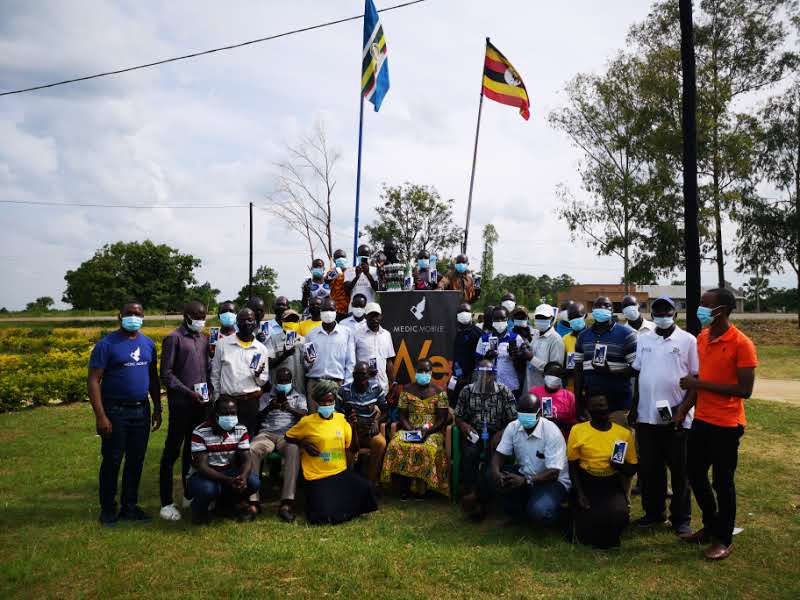
I returned to Uganda in late 2017 and joined Medic in early 2018 as Senior Project Manager and Partnership Specialist. Medic is the technology steward of the Community Health Toolkit, a digital public good used in community health information systems around the world. For five years I worked across Uganda, Kenya, Nepal, and Malawi, leading the work that turned the CHT into Uganda's national electronic Community Health Information System, serving 13,000+ community health workers and integrating with the national DHIS2.
Some of this was strategic — secured $1.7M+ in grants, coordinated with UNICEF, USAID, Rockefeller, WHO and several Ministries of Health, trained 10,000+ community health workers and 2,100 Village Health Teams. Some of it was very much not. Some of it was watching a colleague named Maxwell register SIM cards under a scotched-yellow MTN umbrella at a street corner in eastern Uganda, while 83 Village Health Teams who had never previously owned a smartphone received their first device. Every single thing about that scene — the umbrella, the dust, the queue, the careful way one of the older VHTs handled the phone, like a thing borrowed from a future she had not been invited to — is what the resume bullet trained 10,000+ community health workers actually means in real life. The number is true. The umbrella is truer.
Kampala Leadership Hub
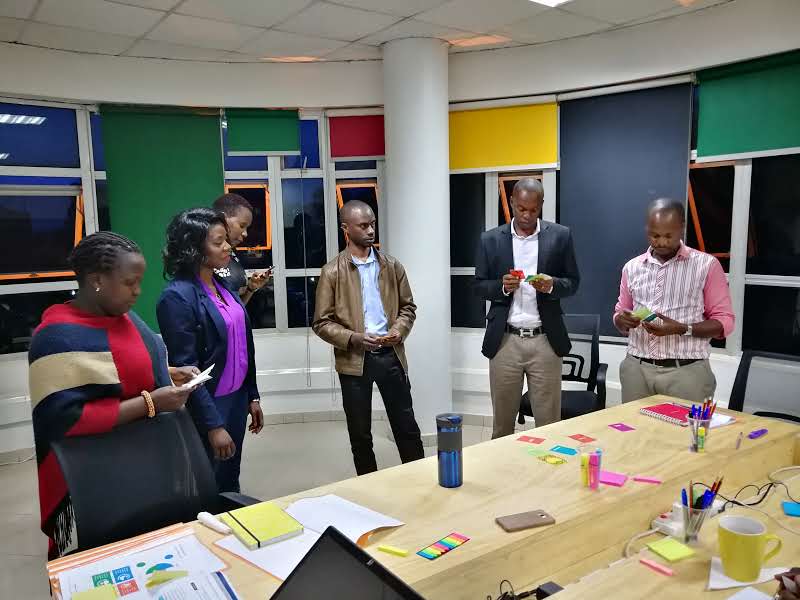
In 2017, somewhere between New York and Medic, I founded Kampala Leadership Hub. KLH carried my other passion — developing people. It started small — a few clients who wanted executive coaching, a curriculum I had been refining since the Watoto leadership work — and grew over seven years into a real consultancy with a flagship 8-week Executive Management Coaching programme that ran for more than 200 managers across multiple sectors. We grew around 30% year-over-year and held an 85% client retention rate, which I attribute mostly to the fact that I will tell anyone, including paying clients, when their idea is bad. In 2024 I closed KLH. Edmonton was on the horizon, and the clients I had built relationships with deserved more than a half-attended consultant operating across nine time zones. In 2026 I registered a new vehicle in Alberta called Olympia & Associates — where the work KLH started continues, in slightly different clothes and with snow boots.
Liberia
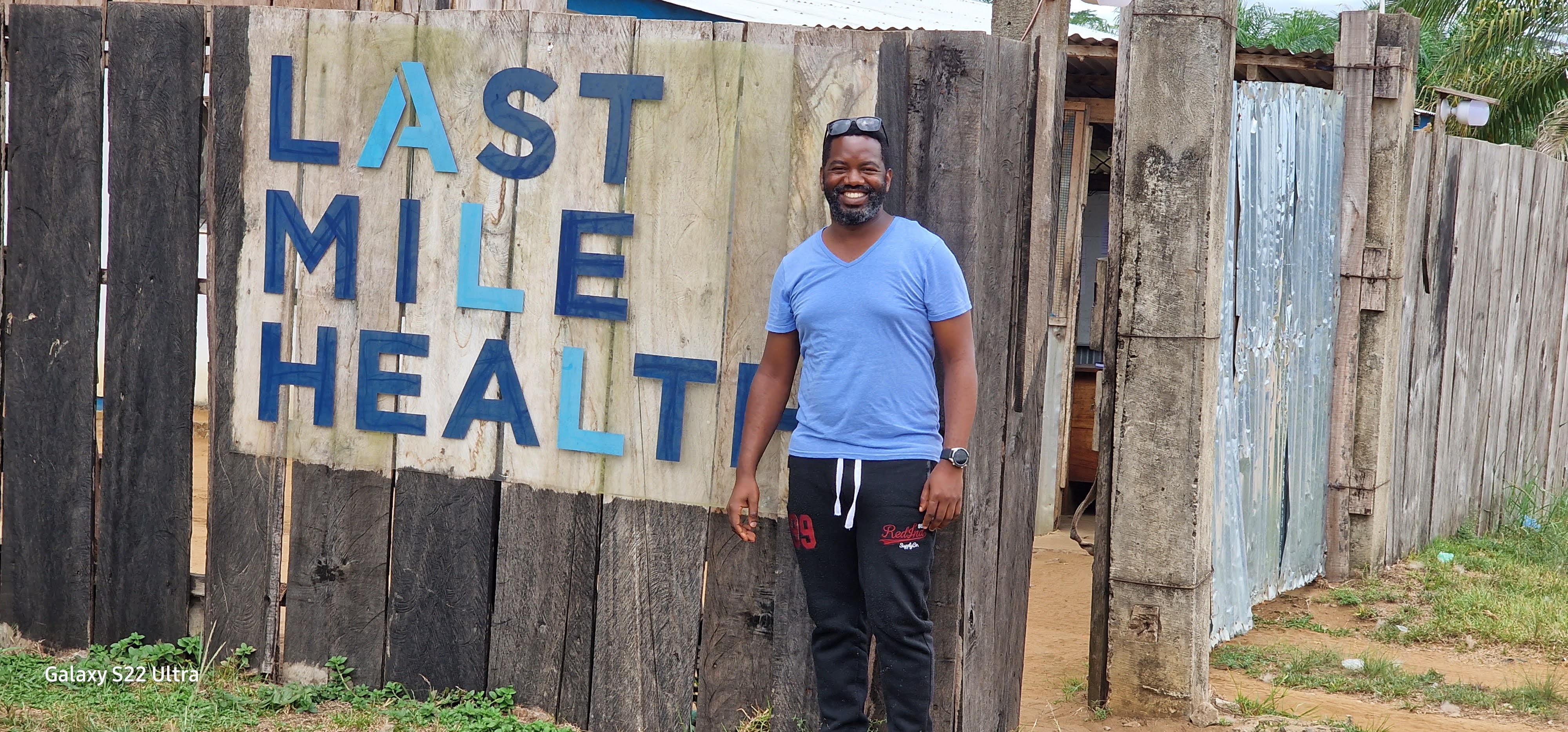
In January 2023 I moved to Monrovia, Liberia, as Director of Digital Health for Last Mile Health, an NGO supporting primary healthcare delivery by community workers in Liberia, Malawi, Ethiopia, and Sierra Leone. My job was to lead the nationwide rollout of Liberia's electronic Community-Based Information System — eCBIS — a digital platform for the 4,000 community health workers serving 1.5 million Liberians, many of them in the country's most remote counties, like Cestos. Communities where the rainy season turns dirt roads into rivers and the last mile is genuinely the last mile.
The project ran on a $1.3M budget over two years, which I managed with cost variance under 5%. I led the OpenSRP2 FHIR adoption that enabled offline data synchronisation and real-time clinical decision support, coordinated relationships across four Health Ministries and a constellation of global partners, and helped secure $1.2M in additional funding. By the close of the pilot, the system had reached 95% user confidence — which is the kind of number you only get when you have actually listened to the people doing the work.
The thing nobody warns you about a national rollout is how often it hinges on small things. A SIM not registered. A charger missing. A supervisor whose phone keeps autocorrecting fever to five. The big architectural diagrams — FHIR servers, sync queues, offline-first state — are the easy part. The hard part is the woman in Cestos who has been doing maternal health for twenty years and is, very reasonably, suspicious of the man from Kampala who has arrived with an Android tablet and a slide deck. And the government department colleague who needs assurance beyond the tech. Earning their confidence is work. The architecture only matters if the work has happened.
Guild Digital Foundation
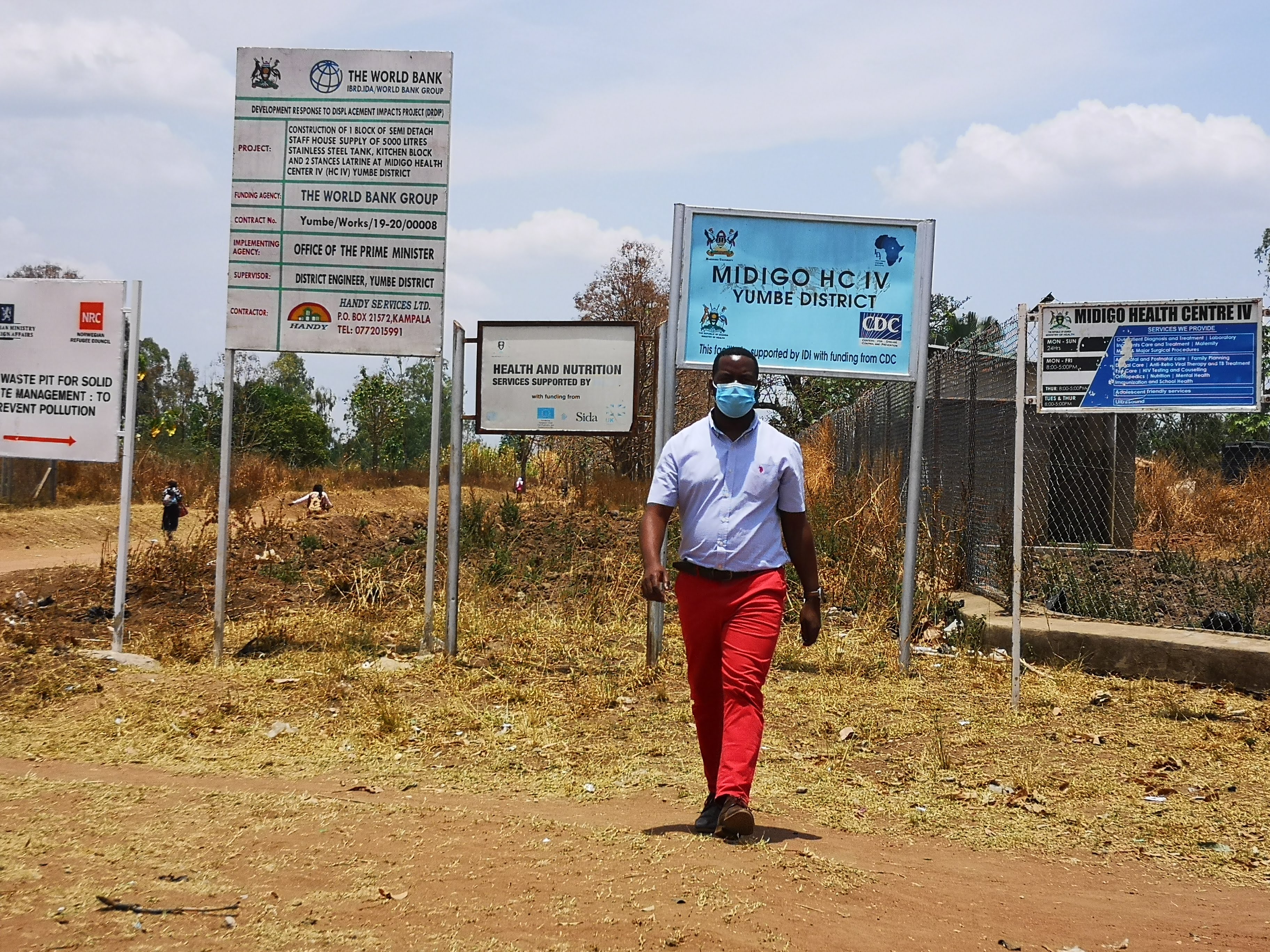
In parallel with Medic and Last Mile, I founded Guild Digital Foundation in 2021 — a registered nonprofit that adapts digital public goods for refugee communities in Uganda. The flagship product is rCHMIS, the refugee Community Health Management Information System, deployed to 1,200 community health teams across 13 refugee settlements, serving more than 810,000 refugees with 92% adoption among frontline workers. We grew Guild to 14 staff, secured $140K+ through partnerships with UNHCR, Dovetail Foundation, and others, and built an offline-first multilingual platform on AWS that improved care coordination by 37% and cut reporting time from fourteen days to three. UNHCR recognised the work as a best-practice model, and in 2024, MOH Uganda assimilated it into the national eCHIS infrastructure — bittersweet. I am, on most days, proudest of the parts that do not quantify — the small mercies of a system that finally fits the user instead of asking the user to fit the system. Those users were refugees, their beneficiaries, fellow refugees.
Edmonton, finally

I moved to Edmonton in the summer of 2024. It is STILL very cold here. Minus twenty-five turns out to describe a category of physical experience my body had not previously contemplated.
In August 2025 I joined the Alberta Machine Intelligence Institute as a Machine Learning Project Manager. Amii is one of three institutes named under Canada's Pan-Canadian AI Strategy — the other two being Mila in Montreal and the Vector Institute in Toronto — sitting at the intersection of fundamental research, applied AI, and industry adoption. My job is to lead end-to-end ML project delivery: defining scope, managing budgets, coordinating data scientists and research fellows and industry clients, and embedding Principled AI Frameworks at every stage. Energy, Startups, Health — and many things in between, I have covered.
In early 2026 I published an open letter on LinkedIn responding to a Ugandan university vice chancellor's claim that AI could generate $500 billion for Uganda. The letter — titled "A bad road cannot lead us home" — argued, with what I hope was the right balance of respect and rigour, that the conditions for that kind of return do not yet exist and that pretending they do is itself a form of harm. It went viral across the Ugandan diaspora and inside Uganda. It is the cleanest version of an argument I have been trying to make for fifteen years: the most important number in any technology pitch is not the size of the market — it is the depth of the conditions on the ground.
The household
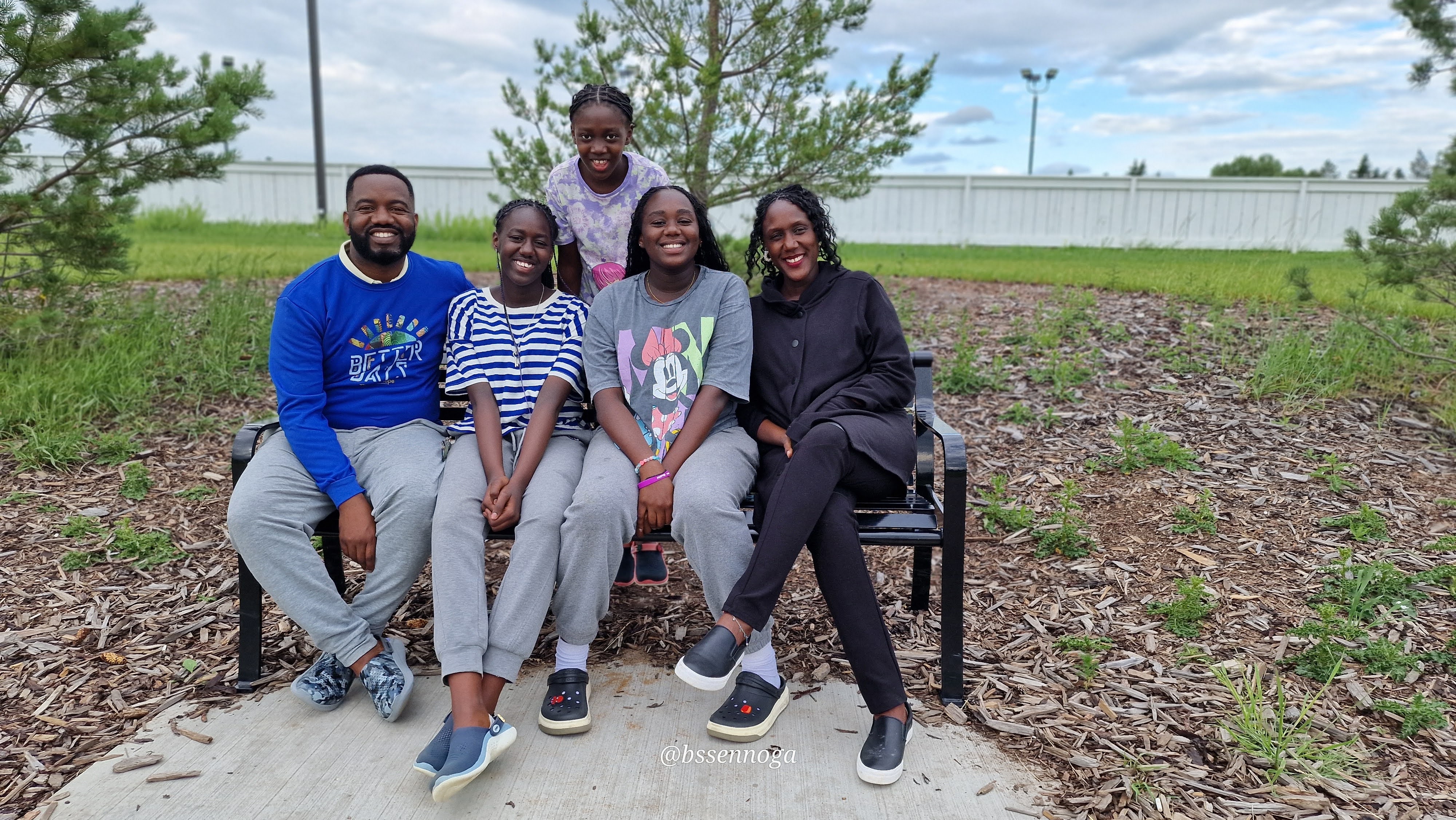
A bio should not end on the work. The work is what I do; it is not what I am.
I live in Edmonton with my wife and our three daughters. Before that, we also had a female dog named Chubby. This makes me, by my own careful count, the only man in a house of five women and a dog who, when I attempt to assert any kind of authority, looks at me as if she has already consulted with the others and decided this is not how things are going to be done.
I still love computers, but I loooove people more. I have used this as a personal tagline since around 2009. I cook, mostly Ugandan food, mostly on weekends, mostly for whoever is around. I play the guitar at a level that should probably be classified as a public utility. I write — sometimes here, sometimes on LinkedIn, sometimes for whoever asks.
If you are reading this because you are considering working with me — at Amii, through Olympia & Associates, or on something neither of us has yet imagined — what you should know is that I am genuinely happy to be reached. The résumé below has the formal version of the same story.
The version above is the truer one.
Résumé — Brian Ssennoga
Full CV including all engagements, skills, and credentials across East Africa, North America, and Canada.
📄 PDF · Updated every 6 months · Next update: November 2026